Time AI · Agent Skill · v1.6.0

一句话,变成一条
可直接出图的 Krea 2 提示词
One short idea, turned into
a ready-to-generate Krea 2 prompt

不是泛泛的"提示词润色器"。它把角色身份落到可见证据上,把地名重建成能画的场景,在你没给环境时自动补一个该角色原作里的经典舞台,并附一段忠实的中文对照。 Not a generic prompt polisher. It anchors character identity in visible evidence, rebuilds named locations into drawable scenes, fills in a canon setting when you leave the environment open, and returns a faithful Chinese translation alongside.

能力Capabilities

八件它特别较真的事Eight things it is strict about

01

身份靠可见证据Identity through visible evidence

发型与发色、眉眼与标记、体型轮廓、招牌服装的层次/颜色/材质、配件道具。按取景挑选 4–7 个最有辨识度的线索,而不是"动漫忍者装"。Hair color and cut, eyes and markings, silhouette, signature costume layers/colors/materials, accessories. Four to seven cues chosen for the framing — never "anime ninja outfit."

02

动作要能画出"这一刻"Action you can actually draw

不写"动态姿势""战斗姿势"。要写清意图、重心与支撑、发力方向、肢体力学,以及环境里的一两个后果 —— 溅开的水、被带起的衣摆、蹬飞的碎石。只定格一个瞬间:预备、决定性接触、或跟随动作。Never "dynamic pose" or "fighting pose." It writes intention, weight and support, direction of force, body mechanics, and one or two consequences in the scene — kicked-up water, trailing cloth, scattered gravel. One instant only: anticipation, the decisive contact, or follow-through.

03

多人之间要有交流Characters actually interact

多人画面先定关系节点:谁先动手、对方怎么回应、视线在哪交汇、接触点在哪、双方身体与空间各自发生什么改变。不再是一排人各摆各的姿势。Multi-character frames start with the relationship beat: who initiates, how the other responds, where eyelines meet, where contact happens, and what changes across both bodies and the space. No more figures posing side by side.

04

场景要重建,不要命名Rebuild the place, don't name it

"天下第一武道会"→ 浅色方石高台擂台、脚下红色界线、环绕的阶梯观众席、红漆立柱、赛事旗帜、瓦顶入口楼阁。"World Martial Arts Tournament" → a raised pale-stone square ring, a red boundary line underfoot, crowded stepped stands, red-painted posts, tournament banners, a tiled-roof entrance pavilion.

05

环境没给就自动补Fills in an open environment

只给角色名、或只给动作/风格/情绪而没给地点时,从该角色的动漫、漫画或游戏原作里挑一个有戏的经典舞台,再把实景写出来。Given only a character name — or an action, style or mood with no location — it picks a story-rich classic stage from that character's anime, manga or game canon and writes the actual scenery.

06

重复请求自动区分Repeat requests stay distinct

对话内记录每个角色用过的场景与动作。再次请求时换一个原作场景和一个动作,不重复同一套地标排布或招牌桥段。It tracks the scenes and actions already used for each character. On a repeat request it changes the canon setting and the action, never reusing a landmark arrangement or signature beat.

07

单一主导画风One dominant style anchor

吉卜力 / 新海诚 / 京阿尼 / Madhouse 都市黑色 / 90 年代机战赛璐璐 / 少女 / 青年 / 经典热血战斗 —— 一个锚点,最多一个有界变体。Ghibli / Shinkai / Kyoto Animation / Madhouse urban-noir / 1990s mecha cel / shoujo / seinen / classic battle-shonen — one anchor, at most one bounded twist.

08

检索诚实Honest about lookup

没真正查到 Krea2 Character Catalog 条目就绝不说"我查过目录"。条目只当证据,不当设定,更不等于"该角色在训练数据里"。It never says "I checked the catalog" unless an entry was genuinely inspected. An entry is evidence, not canon — and never proof that the character is in the training data.

09

看完就用,两步装好Two steps to try it

把仓库放进 skills 目录,下一句直接写角色名就行。Drop the repo into your skills folder, then just name a character.

去安装 →Install →
视频教程Walkthrough

怎么装、怎么用,看这两段How it is installed and used, on video

整条视频里有两段和本页直接相关。09:38 讲动漫角色参考工具 —— 24 个案例里的角色就是从那里挑出来,再交给这个 skill 的;12:08 从放文件夹开始把这个 skill 装好,然后当场跑一遍完整流程。 Two chapters in this video matter here. At 09:38 it covers the anime character reference tool — the characters in the 24 cases above were cast there, then handed to this skill. At 12:08 it installs the skill from scratch and runs a full pass live.

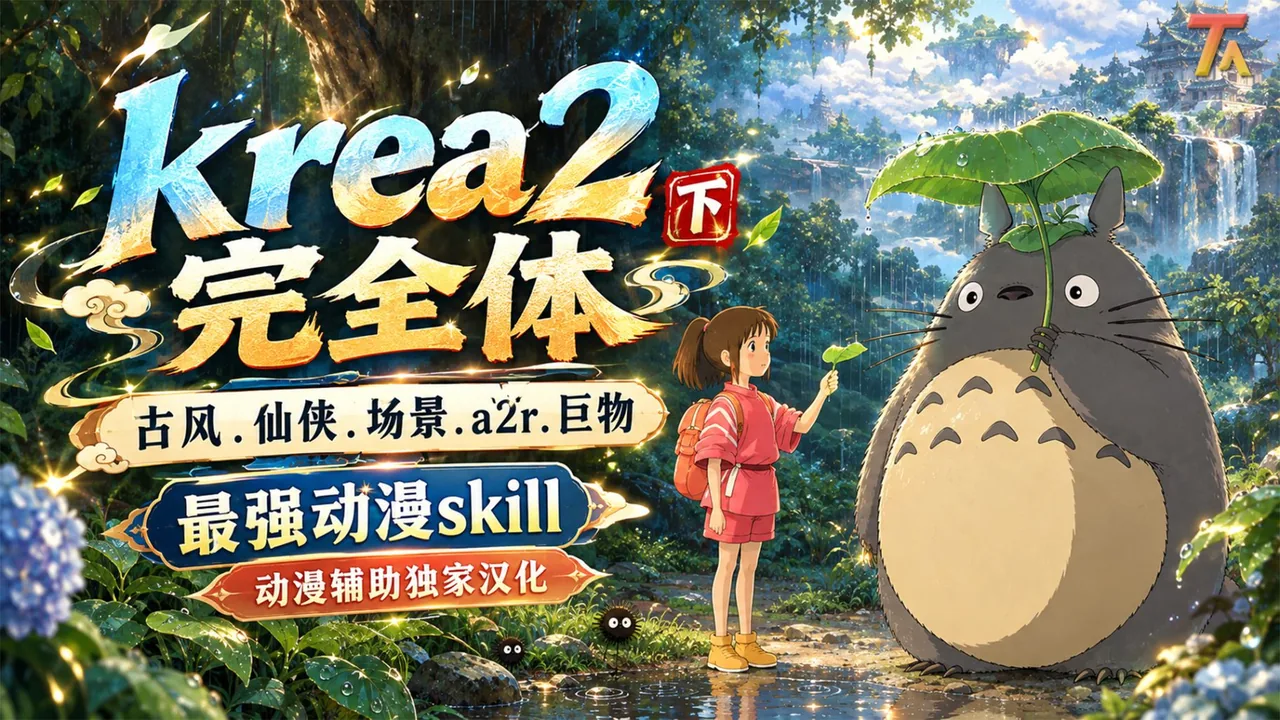
两段都在 B 站,点开后从对应的时间点开始播放。视频标题:Krea 2 完全体(下)· 最强动漫 skill。 Both open on Bilibili and start at the matching timestamp. The video is “Krea 2 完全体 (Part 2) — the strongest anime skill”.

为什么Why

通用提示词助手,和这个 skill 的差别 A generic prompt helper vs. this skill

Krea 2 要的是连贯的自然语言描述,不是 Danbooru 标签串。差别主要在这五处。 Krea 2 wants connected natural-language prose, not Danbooru tag strings. The difference shows up in five places.

通用写法Generic

  • 前置 masterpiece, best quality, 8k 之类质量宏
  • 背景只写"在房间里""在户外"
  • 写"天下第一武道会",指望模型自己知道长什么样
  • 同一个角色永远套同一套默认服装
  • 反复出图都是同一个姿势同一个场景
  • Prepends quality macros like masterpiece, best quality, 8k
  • Leaves the background as "in a room" or "outdoors"
  • Writes "at the World Martial Arts Tournament" and expects the model to know it
  • Pastes one default outfit onto a character forever
  • Every repeat is the same pose in the same place

本 skillThis skill

  • 连贯英文散文,标签只在你要的时候才给
  • 选一个原作经典场景,描述建筑、材质、尺度、光照、天气
  • 把专有名词翻译成可绘制的物理布局与可辨识标识
  • 先判定"故事时刻版本":篇章、地点、身份、变身状态
  • 同一角色再次出现时,场景和动作都换
  • Connected English prose; tags only when you ask for them
  • Picks a canon setting and describes architecture, materials, scale, light, weather
  • Translates proper nouns into a drawable layout and recognizable identifiers
  • Resolves the "story-moment version" first: arc, location, role, transformation state
  • When a character recurs, both the setting and the action change
画风锚点Style anchors

内置画风锚点Built-in style anchors

一个主导锚点,最多一个有界变体。名字只是视觉锚,不是魔法关键词 —— 必须配上具体的配色、线条、光、介质与情绪。One dominant anchor, at most one bounded twist. A name is a visual anchor, not a magic keyword — it must be paired with concrete palette, linework, light, medium and mood.

Studio Ghibli aesthetic手绘水彩感、克制的自然配色、风化的乡间木石、层叠绿意、柔和正午光Hand-painted watercolor feel, restrained natural palette, weathered rural wood and stone, lush greenery, soft midday light
Makoto Shinkai / CoMix Wave Films高饱和天空、细密云缘、阳光耀斑、蓝调时刻渐变、电线与电线杆作前景Hyper-saturated sky, intricate cloud edges, sun flare, blue-hour gradients, wires and poles as framing
Kyoto Animation明亮而微带怅惘、温暖自然窗光、精细纤柔线条、有生活痕迹的室内物件Bright yet gently melancholic, warm window light, delicate linework, lived-in interior objects
Madhouse / urban-noir冷蓝绿配色、硬边赛璐璐阴影、湿沥青、都市密度、钠灯黄点缀Cool blue-green palette, hard cel-shaded shadows, wet asphalt, urban density, sodium-yellow accents
1990s Sunrise / classic OVA mecha硬边赛璐璐、粗犷线条、手绘工业背景、强机械轮廓、厚重阴影Hard-edged cel shading, bold linework, painted industrial backgrounds, strong mechanical silhouettes, weighty shadows
少女 / 青年 / 经典热血战斗Shoujo / seinen / classic battle-shonen纤细轮廓与花卉光点/克制的都市夜色与成人张力/清晰动作剪影与速度线Delicate contours and floral sparkles / restrained city night and adult tension / clear action silhouettes and speed lines
安装Install

一分钟装上Up and running in a minute

整个文件夹放进你的 agent 读取的 skills 目录即可。SKILL.md 与 references/ 必须在一起。Drop the folder into the skills directory your agent reads. SKILL.md and references/ must stay together.

git clone https://github.com/shiguanggougouo/krea2-anime-prompt-director.git .agents/skills/krea2-anime-prompt-director
git clone https://github.com/shiguanggougouo/krea2-anime-prompt-director.git ~/.workbuddy/skills/krea2-anime-prompt-director

第一条适用于 Codex 的仓库内 .agents/skills/;第二条适用于 WorkBuddy 等用户级 skills 目录。 The first suits a repo-local .agents/skills/ (Codex); the second suits a user-level skills directory such as WorkBuddy's.

目录结构Repository layout

krea2-anime-prompt-director/ ├── SKILL.md 核心行为 + 工作流 + 输出格式core behavior, workflow, output format ├── README.md 英文 / EnglishEnglish edition ├── README.zh-CN.md 中文版Chinese edition ├── CHANGELOG.md 版本更新日志version history ├── LICENSE MIT ├── docs/ │ └── index.html 本页(GitHub Pages 源,中英双语)this page (GitHub Pages source, bilingual) └── references/ ├── action-direction.md 动作与角色互动规范action staging and interaction ├── style-language.md 风格矩阵 / 场景语言库 / 提示词骨架style matrix, language bank, scaffolds ├── examples.md 完整中英示例full EN/CN examples ├── catalog-workflow.md Catalog 证据化处理流程evidence-aware catalog workflow └── source-notes.md 来源链接、结论与验证边界sources, findings, verification limits

怎么用How to use it

用 krea2-anime-prompt-director 扩写:海绵宝宝和派大星
诚实边界Honest limits

它不做什么What it does not do

不自带 Krea2 Character Catalog 数据集。只有真的存在可访问条目、导出文件或你提供的文件时才使用;查不到就继续用可靠知识,不伪造引用。 It does not bundle the Krea2 Character Catalog dataset. It uses an accessible entry, export or provided file when one exists, and otherwise continues with reliable knowledge instead of fabricating a citation.
目录条目是临时性的。匹配结果只是有用证据,不等于设定,更不等于"该角色在 Krea 2 训练数据里"。 Catalog entries are provisional. A match is useful evidence, not canon, and never proof that the character exists in Krea 2's training data.
不保证系列一致性。纯文本提示词无法锁死角色连续性;做系列请用 Krea 2 的风格参考,或 20–40 张参考图组成的 mood board。 Series consistency is not guaranteed. Prompt text alone cannot lock character continuity; use a Krea 2 style reference or a mood board of roughly 20–40 frames.
默认不输出负面提示词。除非你明确要求单独给一份 negative prompt。 No negative prompt by default. Only when you explicitly ask for a separate negative prompt.
工作流Workflow

它内部怎么走How it works internally

除真正的必要歧义外,它默认自行推断并直接出文,不反问。Unless an essential ambiguity blocks a coherent result, it infers sensible defaults and writes the prompt instead of asking.

  1. 分类意图Classify the intent

    角色+原作世界(未指定环境)/角色+指定环境/动作战斗/纯背景/原创角色/风格探索。保留你给的任何画幅、机位、动作、服装、时代或情绪。Character + canon world (no environment) / character + specified environment / action or combat / background only / original character / style exploration. Any aspect ratio, camera angle, action, costume, period or mood you gave is preserved.

  2. 解析"故事时刻版本"Resolve the story-moment version

    先决定你要的是哪个篇章、地点、身份、变身状态或时期的形态 —— 头发、服装、装备、年龄、伤势、状态都随之改变,不把默认设计贴到每个场景上。Decide which arc, location, role, transformation state or time period you want. Hair, costume, equipment, age, injuries and condition all follow — one default design is never pasted onto every scene.

  3. 设计动作与互动Design the action and the exchange

    为这一刻写一个可画的动作:意图、重心与支撑、发力方向、肢体力学,并让环境在接触点给出反应。多人则先定关系节点 —— 谁先动手、谁回应、视线与接触点落在哪里。只定格一个瞬间:预备、决定性接触、或跟随动作。Write a drawable action for this beat: intention, weight and support, direction of force, body mechanics, plus a reaction at the contact point in the environment. With several characters, decide the exchange first — who initiates, who responds, where eyelines and contact land. One instant only: anticipation, the decisive contact, or follow-through.

  4. 自动补全未指定的环境Fill in an unspecified environment

    没给地点就不留白:从原作挑一个有叙事意义、视觉上记得住的舞台,用至少三个场景专属标识 + 前景/中景/远景 + 统一的时间天气光照氛围把它写实。No location means no blank background: pick a narratively meaningful, visually memorable canon stage and ground it with at least three scene-specific identifiers, foreground/middle/distance planes, and one coherent time, weather, light and atmosphere.

  5. 把专有名词翻译成可绘制描述Translate names into drawable descriptions

    物理类型与布局 → 可见标识 → 空间摆位 → 材质尺度氛围 → 与这一幕剧情的关联。专有名只作为可选锚点,不代替画面描述。Physical type and layout → visible identifiers → placement in space → materials, scale, atmosphere → the tie to this story beat. The proper name is only an optional anchor, never a substitute for the description.

  6. 选定一个视觉语言Choose one visual language

    参考内置风格矩阵选主导锚点;画风只影响线条、配色、光照与质感,不覆盖角色的招牌设计。Pick a dominant anchor from the built-in style matrix; style shapes linework, palette, light and texture but never overwrites the character's signature design.

  7. 按稳定顺序搭画面Build the frame in a stable order

    媒介与意图 → 焦点主体与身份 → 具体地点与剧情节点 → 前景 → 中景 → 背景纵深 → 光照与配色 → 渲染与情绪基调。Medium and intent → focal subject and identity → specific place and story beat → foreground → middle ground → background depth → lighting and palette → rendering and emotional register.

  8. 套用场景密度标准Apply the scene-density standard

    两到三个空间层次、三个以上具体场景标识、一套自洽光照、一个受控配色、一到两个大气运动、一个构图线索。Two or three spatial planes, three or more concrete scene identifiers, one coherent light setup, one controlled palette, one or two atmospheric movements, one composition cue.

  9. 输出 POSITIVE + 中文对照Output POSITIVE + Chinese translation

    角色入景约 150–350 词,纯背景约 120–300 词。去掉质量宏与过时的 Anima 语法;中文忠实对应英文的每一项视觉决策。About 150–350 words for a character-in-scene prompt, 120–300 for background-only. Quality macros and obsolete Anima syntax removed; the Chinese mirrors every visual decision in the English.

更新日志Changelog

从 1.0.0 到 1.6.0From 1.0.0 to 1.6.0

每一版都来自一次实际的出图痛点。完整文件见仓库的 CHANGELOG.md。Every version came out of a real generation pain point. Full file: CHANGELOG.md in the repo.

Site2026-10-20 案例画廊上线Case gallery
  • 新增 24 个真实案例:原始输入、skill 返回的完整提示词、Krea 2 成图,位置就在 Hero 正下方
  • 点开任意案例看大图与全文,支持 ← → 翻页、Esc 关闭
  • 每个案例有独立链接(如 #case-7),可直接分享单张
  • 整站视觉改版:暖白底、图片优先,卡片编号与图下小字整条去掉,旧版日志折叠收起
  • 板块顺序重排:案例 → 能力 → 为什么 → 画风 → 安装 → 边界 → 工作流 → 更新日志
  • 首三张固定为千寻 × 龙猫、海绵宝宝 × 派大星、卡尔 · 气球屋,其余仍按输入词数排序
  • 新增教程板块(在能力之后):B 站视频 09:38 的动漫角色参考工具、12:08 的安装与使用,点开直接从对应时间点开始播
  • Hero 按钮组中间加了「看视频教程」直达;画廊头部那组「24 组成图 / 组提示词 / 句输入」统计去掉
  • Added 24 real cases — original input, the full prompt the skill returned, and the Krea 2 render, right under the hero
  • Open any case for the full image and text; ← → page through, Esc closes
  • Every case has its own shareable link, e.g. #case-7
  • Visual refresh: warm off-white, image-first cards, both the index and the small caption line gone, older entries folded
  • Section order reshuffled: cases → features → why → styles → install → limits → workflow → changelog
  • The first three cards are pinned: Chihiro & Totoro, SpongeBob & Patrick, Carl and the balloon house — the rest still follow input length
  • New tutorial section right after the features: the character-reference tool at 09:38 and the install-and-use walkthrough at 12:08, each opening the Bilibili video at that exact timestamp
  • A "watch the walkthrough" button in the middle of the hero, and the gallery's image/prompt/input stat block is gone
这是站点更新,技能本身仍是 1.6.0。图片在 Krea 2 中生成,提示词为 skill 原始返回,未做二次润色。 This is a site update; the skill itself is still 1.6.0. Images were rendered in Krea 2, and the prompts are the skill's unedited output.
1.6.02026-10-19 动作与角色互动Action and interaction
  • 起因:出图里角色动作很"呆" —— 并排摆姿势、动作和环境没关系、多人之间没有互动
  • 新增 references/action-direction.md:动作与角色互动的完整方法
  • 动作必须有明确意图、重心与支撑、发力方向,并在环境里留下可见后果;"动态姿势""战斗姿势"不算
  • 只定格一个瞬间:预备、决定性接触、或跟随动作,不把连续动作塞进一帧
  • 场景要参与动作:墙、树枝、栏杆、台阶、水流、阵风成为支点或阻力,并给出接触点的反应
  • 多人画面要有可读取的交流:谁先动手、谁回应、视线交汇在哪、接触点在哪、身体与空间各自改变了什么
  • 新增两组中英案例:林克暴雨山道跃越(单人动作与环境耦合)、悟空与比克对练(双人攻防与反应)
  • Trigger: generated characters looked stiff — parallel posing, actions unrelated to the location, no interaction between figures
  • Added references/action-direction.md: a full method for action and character interaction
  • Every action needs a clear intention, weight and support, and direction of force with a visible consequence — "dynamic pose" is not enough
  • One instant only: anticipation, the decisive contact, or follow-through — never a narrated sequence in a single frame
  • The setting participates: walls, branches, railings, stairs, water and gusts enable, interrupt or redirect the movement
  • Multi-character frames stage a readable exchange: who initiates, who responds, where eyelines meet, where contact happens, and what changes in both bodies and space
  • Two new EN/CN examples: Link leaping a collapsed mountain path in a storm and Goku sparring with Piccolo
依据:Krea 对动势、重量感与焦点瞬间的说明;Disney Animation 关于预备动作、跟随动作、清晰调度与角色反应的原则。这是单帧提示词的写作方法,不等于 Krea 2 会模拟动画物理。 Basis: Krea's notes on motion, weight and focal beats, and Disney Animation's principles of anticipation, follow-through, clear staging and character reaction. This is single-frame prompt writing — not a claim that Krea 2 simulates animation physics.
更早的 6 个版本(1.5.0 – 1.0.0) Six earlier versions (1.5.0 – 1.0.0)
1.5.02026-10-18 扩写输出长度Longer output
  • 长度目标提高:角色入景约 100–180 词 → 150–350 词;纯背景约 80–160 词 → 120–300 词
  • 所有案例的英文提示词与中文对照同步扩写,增补姿态与服装细节、场景空间层次、光线氛围与画风
  • 扩写以增加可视化信息为准,不用重复形容词凑长度
  • Raised length targets: character-in-scene ~100–180 → 150–350 words; background-only ~80–160 → 120–300 words
  • Expanded every example's English prompt and Chinese translation with pose/costume detail, spatial layering, light, atmosphere and rendering
  • Expansion adds visual information, not repeated adjectives
说明:这是目标区间,不是对每条输出精确 +50% 的承诺。案例扩写幅度约为 50% 或更多,但实际生成的长度仍取决于具体请求。 Note: these are target ranges, not a guarantee of exactly +50% per output. The examples grew by roughly 50% or more, but real generation length depends on the request.
1.4.02026-10-18 把场景名还原成画面Names become drawable scenes
  • 新增"把场景名称转成可画描述"的规则:先说明物理类型与布局,再写出标志性建筑、物件、材质、空间关系、规模与氛围
  • 场景专名只能作为辅助锚点,不能代替画面描述 —— AI 并不理解"天下第一武道会"这个名字
  • 改写孙悟空案例:方形浅色石擂台、红色界线、环绕的阶梯观众席、瓦顶入口楼阁、赛事旗帜
  • Added a rule for turning scene names into drawable descriptions: physical type and layout first, then visible identifiers, materials, spatial relations, scale and atmosphere
  • A proper name is only a supporting anchor — the model does not know what "World Martial Arts Tournament" looks like
  • Rewrote the Goku example: pale square stone ring, red boundary line, stepped stands, tiled entrance pavilion, tournament banners
1.3.02026-10-18 自动补全经典场景Automatic canon setting
  • 只要用户没指定环境就自动补全 —— 不只是"只输入角色名",给了动作、风格或情绪但没给地点同样适用
  • 覆盖范围扩大到动漫、漫画与游戏角色
  • 同一角色在对话中再次出现时,场景和动作都必须换(除非用户明确要求复现或续写)
  • 新增《塞尔达传说:旷野之息》林克未指定环境的中英文案例
  • Fills in a classic canon setting whenever the environment is open — not just a bare character name, but also requests that give an action, style or mood without a location
  • Extended to anime, manga and game characters
  • When a character recurs in a conversation, both the setting and the action must change (unless a repeat or continuation is requested)
  • Added a Breath of the Wild Link example with no environment specified
1.2.02026-10-18 角色外观跟随剧情Appearance follows the story
  • 先判定剧情阶段、地点、身份或变身状态,再写外貌和服装;不再把默认造型套到所有场景
  • 禁止跨阶段混搭特征 —— 不能把某一形态的头发和另一形态的服装拼在一起
  • 新增中英文对照案例:悟空那美克星超级赛亚人(金发)/地球普通形态(黑发);千寻汤屋工作装(红色宽松上衣)/非工作装(绿白条纹)
  • Resolve the story moment, location, role or transformation state before describing appearance and costume — one default design is never pasted everywhere
  • Never mix traits across story moments — no golden hair from one form with the costume of another
  • Added paired EN/CN examples: Goku Super Saiyan on Namek (golden hair) vs. ordinary on Earth (black hair); Chihiro at work in the bathhouse (loose red top) vs. off duty (green-and-white stripes)
1.1.02026-10-18 强化角色特征Stronger identity cues
  • 强化角色特征描述标准:优先写清发型、脸部特征、身形轮廓、标志性服装与配饰
  • 根据镜头远近取舍细节,避免特征被构图或特效遮住
  • 角色案例的英文提示词与中文对照同步改写;纯场景案例保留原样
  • Strengthened the character-identity standard: hair, face and markings, silhouette, signature costume and accessories come first
  • Detail is selected by framing, so identity cues are not hidden by composition or effects
  • Character examples rewritten in both languages; environment-only examples left unchanged
1.0.0— 首个版本First release
  • 整合 Krea 官方两篇动漫指南与社区项目 Krea2 Character Catalog 的证据化流程
  • 定义 POSITIVE + 中文对照 的双段输出格式
  • 建立风格选择矩阵与场景设计语言库
  • Synthesizes Krea's two official anime guides with an evidence-aware workflow for the community Krea2 Character Catalog
  • Defines the two-section output format: POSITIVE + 中文对照
  • Establishes the style-selection matrix and the scene-design language bank